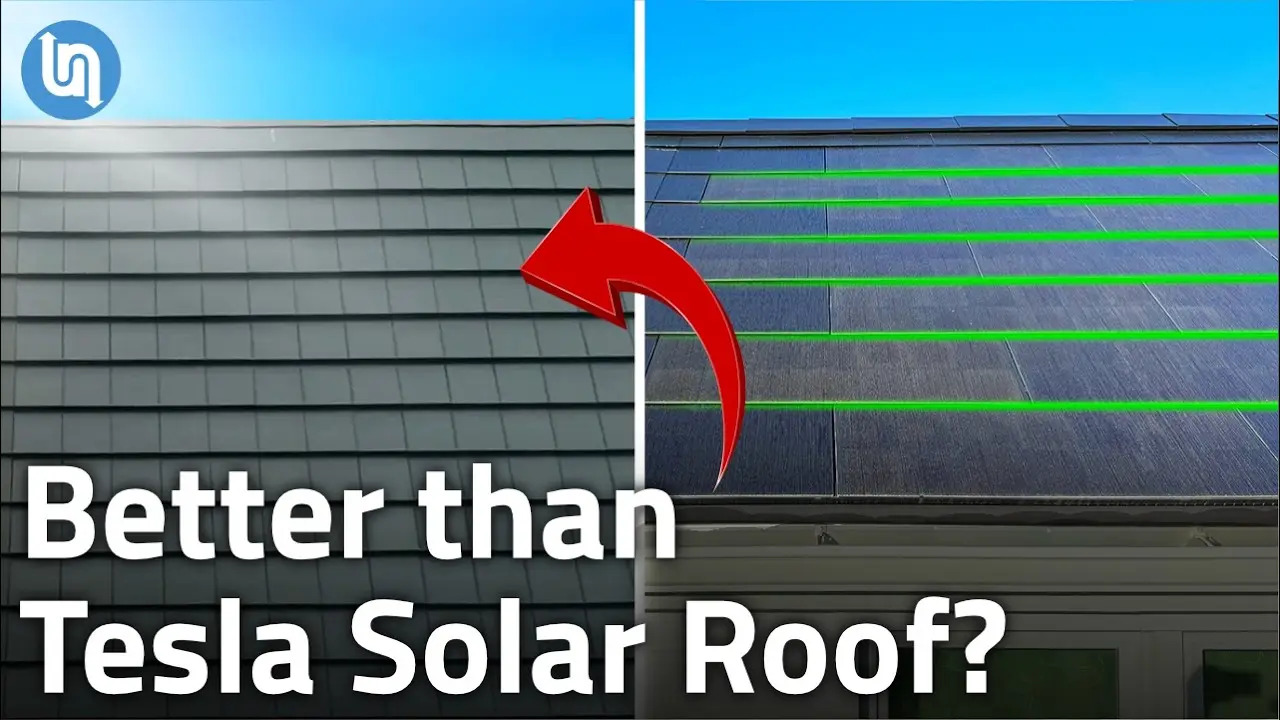
Solar roof tiles are gaining popularity in new home construction as they eliminate the need for traditional solar panels mounted on top of roofs, integrating somewhat seamlessly(?) into the roof itself.
Regular readers of my articles know I recently built a ground-mounted solar array, which to me offers easier cleaning and maintenance while keeping my roof clutter-free. However, not everyone has the luxury of space for ground-mounted panels like I do, making rooftop solar panel solutions the only viable option.
Companies like Tesla have been developing and selling solar tiled roofs for over five years, but the question remains: are they truly a good option? While solar tiles undeniably look better, I have reservations. The solar industry is rapidly developing more affordable and efficient solar panels, and the thought of permanently installing solar roof tiles that could become outdated within a few years – even months, gives me pause.
I’m passionate about efficiency – the more, the better. I want to extract every possible watt from my panels to minimize electricity bills, and with traditional panels becoming so affordable, replacing them every five or so years for more efficient panels is becoming economically viable. But can you replace solar roof tiles as easily?
As I’m currently designing my next house to be off-grid, I’m particularly interested in manufacturers’ promises regarding solar roof tiles. One thing’s certain: it won’t be a Tesla Solar Roof, as more affordable options have emerged, and my experience with my Tesla company car hasn’t exactly been stellar – but that’s a story for another day.
Our colleague Matt Ferrell is examining an intriguing hybrid solar tile and heat pump solution. While I love the concept, my adoption criteria remain stringent: the solar roof tiles must be cost-effective and easy to maintain and replace. Similarly, the heat pump needs to be straightforward to operate and maintain, and above all, reliable – qualities I can’t attribute to my current air-to-water heat pump, which has faced numerous challenges over the years.
Let’s turn to Matt Ferrell’s analysis of this particular solar roof tile and heat pump solution.
The Genius of a Hybrid Solar Tile and Heat Pump
Video Summary and key points
Solar panels aren’t exactly pros at handling the sun. Sounds backward, but excess heat can be a big problem for solar panels. It drags down their efficiency and can even shorten their lifespan.
So, how do you keep something that’s basking in the sun all day from overheating? One solution is to combine solar panels with a heat pump.
The heat pump swoops in, grabs the excess heat from the panels, and repurposes it to warm your home or water. This dynamic duo keeps the panels cooler, helps the heat pump work more efficiently, and saves you money. But if this combo is such a great idea, why haven’t we been doing it all along? And do the potential energy savings really make up for the hefty upfront costs?
Solar Assisted Heat Pump (SAHP)
So our challenge is tackling the solar panel efficiency loss due to high temperatures and conversely heat pump performance issues in cold weather. A potential solution is to use a Solar Assisted Heat Pump (SAHP), particularly a system developed by German company paXos Solar.
The fundamental problem addressed is quite counterintuitive: solar panels actually struggle with excessive heat despite their purpose of harvesting solar energy. As temperature increases, solar panel efficiency decreases – specifically, for every 1°C rise in temperature, a panel’s efficiency can drop by about 0.5% (though this varies by panel). Meanwhile, heat pumps face the opposite challenge: they become less efficient in colder temperatures, sometimes requiring backup heating elements that reduce their energy-saving benefits.
The Solar Roof Tiles Redirect Surplus Heat to The Heat Pump
The SAHP system elegantly addresses both issues by creating a symbiotic relationship between solar panels and heat pumps. The paXos solution uses specially designed PV tiles that replace traditional roofing (similar to Tesla’s Solar Roof concept). These tiles are installed over a water-bearing layer with an air gap underneath. When the air under the tiles becomes at least 1 Kelvin warmer than the ambient temperature, a fan activates, directing this warm air to the heat pump’s heat exchanger. This process serves two purposes: it cools the solar panels, maintaining their efficiency, while providing additional warmth to the heat pump.
The benefits of this system are significant. According to testing by the Technical University of Cologne, the setup can reduce the heat pump’s energy consumption by about 20% annually compared to standard systems. The heat pump’s coefficient of performance (COP) can improve by nearly 25% under favorable weather conditions. For context, heat pumps typically achieve a COP greater than 1, meaning they output more heat energy than the electricity they consume, with some reaching a COP of 3 or higher.
The history of SAHPs dates back to 1955, when researchers E.R. Ambrose and Philip Sporn first explored combining solar collectors with heat pumps. NASA developed the first recognizable SAHP in 1973, during the energy crisis. The technology has particular relevance today, as heating and cooling account for 45% of residential energy use, with water heating adding another 12.9% (according to University of Michigan data).

SAHP Adoption Challenges
However, despite these advantages, SAHPs haven’t achieved widespread adoption. Several challenges exist:
- Weather Dependency: SAHPs can struggle in cold, cloudy weather when the heat pump needs the most assistance, but solar panels can’t provide optimal support.
- System Complexity: The integration of solar and heat pump components requires precise calibration to balance changing air temperatures, sunlight levels, and building heating/cooling needs.
- Cost Considerations: The combination of solar roof installation and heat pump technology results in significant upfront costs. Installation costs are further increased by the specialized nature of the technology and limited availability of trained installers.
Greater Efficiency than a Tesla Solar Roof
When comparing paXos’ system to Tesla’s Solar Roof, some interesting contrasts emerge. PaXos claims a cost of about €260 ($271) per square meter, compared to Tesla’s approximately $461.50 per square meter. PaXos reports an output of around 189 W/m² (though calculations based on tile dimensions suggest closer to 175.3 W/m²), while Tesla’s latest Solar Roof achieves 165 W/m².
The Future os SAHP
The future of SAHP technology appears promising, particularly in countries with strong solar adoption rates like Germany (12.3% compared to the U.S.’s 3.4%). The technology is considered mature enough for continuous use under real conditions, achieving a relatively high Technology Readiness Level (TRL). However, there’s still room for improvement, and the technology benefits from advances in both solar panel and heat pump technology.
Conclusion
In conclusion, while SAHPs represent a clever solution for maximizing renewable energy efficiency, their success depends heavily on local conditions, including climate, installation costs, and energy prices. For locations with suitable conditions, they offer an elegant way to address the limitations of both solar panels and heat pumps while potentially providing significant energy savings. The technology’s future may be particularly bright in regions already embracing renewable energy solutions, though widespread adoption will likely depend on continued improvements in cost-effectiveness and installation infrastructure.
Full article can be found here
Related
ABN Supplier: Ennogie Solar Roof
ABN Supplier:Intelligent Solar
Join the Community Solar Movement: Unlock Solar Energy
Tesla Solar Roof – A Builders Perspective
.