When it comes to residential construction the choices we make during the design and building system specification phase will dramatically impact a home’s performance, durability, and long-term maintenance costs. Two recent construction projects, one from the United States showcasing advanced building science principles and another from Australia representing cost-focused volume construction illustrate just how different these outcomes can be.
For me they are light and day apart, one I wouldn’t choose for even the taxmanmy worst enemy, and one I fully endorse.
The High-Performance Approach: Systems Thinking in Action (USA)
This American project demonstrates what happens when builders prioritise building performance, health, and durability. This home features a comprehensive approach to moisture and air control using ZIP System sheathing with integrated weather-resistant barriers. The builders create continuous control layers by carefully taping seams and managing transitions from wall to roof.
What sets this project apart is the “monopoly framing” or “perfect wall” approach where exterior sheathing extends up the wall and connects directly to roof sheathing, creating unbroken air and water control. But here’s the clever part: instead of risking this critical barrier during future roof replacements, they’ve designed a dual-roof system. The structural roof with its control layers remains untouched, while a secondary sacrificial roof above handles all the roofing materials that will need replacement over the home’s lifetime.
The attention to detail extends to window installations using stretch tape for complex geometries, and the addition of an offset rain screen system that creates a drainage cavity behind the surface cladding. This allows water to drain freely rather than being trapped against the building envelope.
The Volume Builder Reality: Cost Over Performance (Australia)
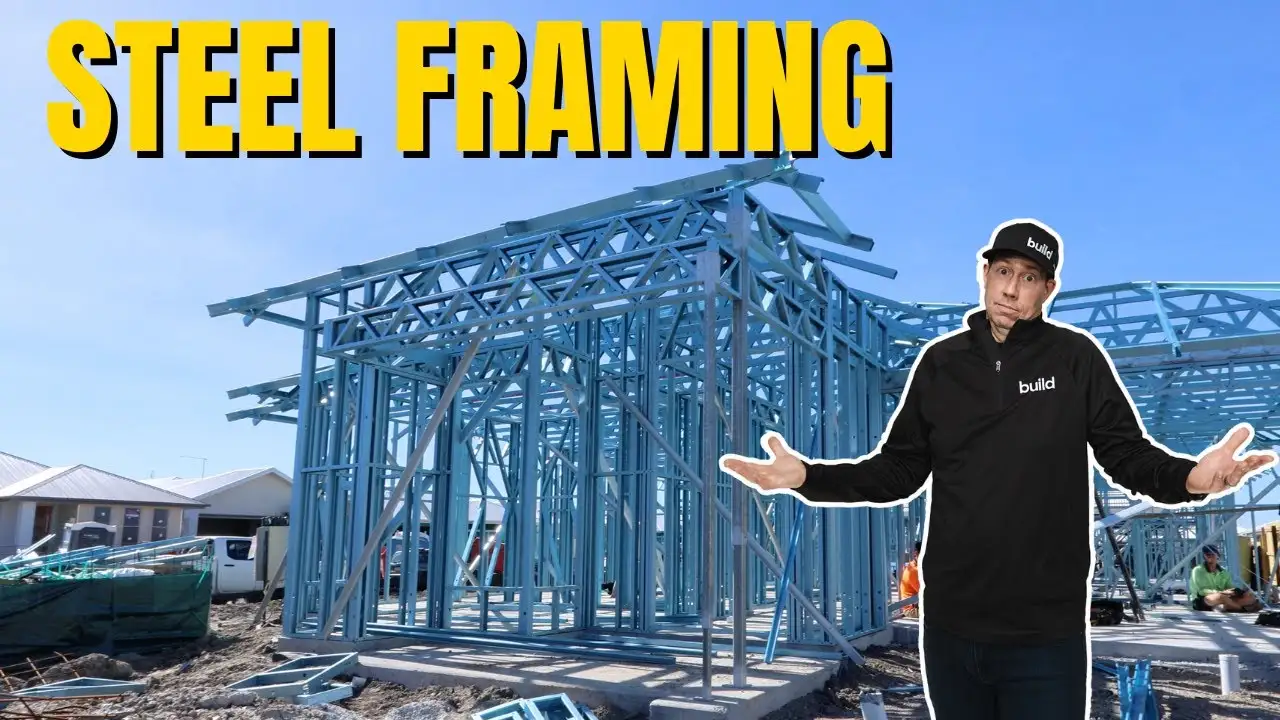
In stark contrast, the Australian project represents typical volume builder construction focused primarily on build cost savings. Steel framing dominates, offering 20-30% cost reduction compared to timber framing. Timber in New Zealand and Australia is exceptionally high while key suppliers take a somewhat unfair advantage of our stretched development budgets. I can’t believe suppliers still mention the word Covid as being the reason for almost monthly price hikes. Whilst steel provides excellent resistance to termites and flooding, critical considerations in subtropical climates, it creates significant thermal bridging issues and my own observations with reverberation around the house when a door slams. Not my favourite building system choice if I’m honest.
Steel has essentially zero R-value and conducts heat readily, making it a thermal highway through the building envelope. Without adequate exterior insulation, this creates prime conditions for condensation when humid outdoor air meets cool interior surfaces. In Brisbane’s subtropical climate, with average humidity levels in the 60-70% range, this becomes a real concern.
The construction details reflect 1970s-era American building practices: house wrap directly over framing, ductwork in unconditioned attic space, and minimal attention to air sealing. With building codes requiring only 10 ACH50 for air tightness (compared to much stricter standards in high-performance construction), these homes are essentially sieves for air movement.
The Mathematics of Moisture and Health
The performance gap becomes clear when you run the numbers. On a typical Brisbane summer day 29°C (84°F) with 65% relative humidity, the dew point sits at 21°C (71°F). Any surface at or below this temperature in an air-conditioned home becomes a condensation risk. Steel framing, with its excellent thermal conductivity, creates multiple potential condensation sites throughout the wall assembly, and if that moisture can’t escape then problems start to mount quickly.
This isn’t just a comfort issue—it’s a health concern. Uncontrolled moisture creates ideal conditions for mould growth, dust mites, and other allergens. The leaky construction typical of volume building allows humid outdoor air to constantly infiltrate, carrying pollutants, allergens, and moisture that the building systems can’t adequately control.
Your Family’s Health: The Hidden Cost of “Cheap” Construction
When choosing between these approaches, consider what’s truly at stake for your family’s wellbeing:
Indoor Air Quality: The high-performance American home uses controlled ventilation—fresh air enters through filtered, conditioned pathways rather than random leaks. The Australian volume home relies on natural infiltration, meaning outdoor pollutants, humidity, and allergens enter uncontrolled.
Mould and Moisture: Proper air sealing and moisture control in the US example prevents the condensation that feeds mould growth. The thermal bridging and air leakage in the Australian example creates multiple opportunities for moisture problems.
Temperature Stability: Consistent temperatures reduce stress on occupants and improve sleep quality. The thermal bridges and air leaks in volume construction create hot and cold spots that force HVAC systems to work harder whilst delivering inferior comfort.
Respiratory Health: Children with asthma, elderly family members, and anyone with respiratory sensitivities particularly benefit from controlled indoor environments that high-performance construction provides.
The Real Cost Equation: Performance May Cost Less Than You Think
Here’s where the conversation gets interesting: the cost gap between these approaches may be smaller than you imagine, especially when working with builders who understand value engineering.
Smart high-performance builders focus on:
- Strategic material sourcing: Buying quality materials at volume pricing
- System integration: Using products that serve multiple functions (like ZIP sheathing providing structure, air barrier, and water barrier in one)
- Labour efficiency: Training crews in proper installation techniques that actually save time
- Energy modelling: Right-sizing mechanical systems for efficient buildings reduces equipment costs
When you factor in the energy savings—potentially 30-50% lower utility bills over the home’s lifetime, the payback period can be surprisingly short.
A family spending £3,000 annually on energy in a volume-built home might spend only $1,500-2,000 in a high-performance home. Over a 30-year mortgage, that $1,000-1,500 annual savings adds up to $30,000-45,000.
Add the health benefits, well, fewer sick days, reduced medical costs from respiratory issues, better sleep leading to improved productivity, and the “expensive” high-performance home often delivers better value from day one, and resale value.
Long-Term Implications: Maintenance vs. Performance
These contrasting approaches represent fundamentally different philosophies about home ownership costs. The high-performance American home requires higher upfront investment but delivers:
- Predictable maintenance cycles: The dual-roof system means roofing replacements never compromise the building envelope
- Energy efficiency: Continuous insulation and air sealing dramatically reduce heating and cooling loads
- Durability: Proper moisture management prevents the building science failures that lead to expensive repairs
- Healthier living: Controlled ventilation and moisture management create environments where families thrive
The Australian volume-built home offers lower initial costs but potentially higher lifetime expenses:
- Energy penalty: Thermal bridging and air leakage increase utility costs indefinitely
- Maintenance uncertainty: Building envelope compromises during routine maintenance
- Moisture risks: Poor air sealing and thermal bridging create condensation potential
- Health costs: Uncontrolled indoor environments contribute to respiratory issues and discomfort
The Choice Is Yours, And Your Family’s
Whether you’re designing, building, or buying a home, these examples illustrate that construction quality isn’t just about aesthetics or immediate function, it’s about long-term performance, health outcomes, and true cost of ownership.
For your family’s sake, consider this: Would you rather save money upfront and spend decades managing the consequences, or invest wisely in a home that protects your family’s health whilst potentially costing no more over its lifetime? The reality is a well built home using an experienced and efficient builder can actually be cheaper than the inefficiently built volume home.
The building science is clear – we know how to build homes that perform well over time whilst supporting human health. The question is whether we choose to apply that knowledge or continue building like it’s still 1950, accepting the health and financial consequences of that decision.
Your family deserves better. The technology exists. The question is simply whether you’ll demand it. I know which one I would buy.
Contributor
Related
Building Systems 101 – Are you Making the Right Choice?